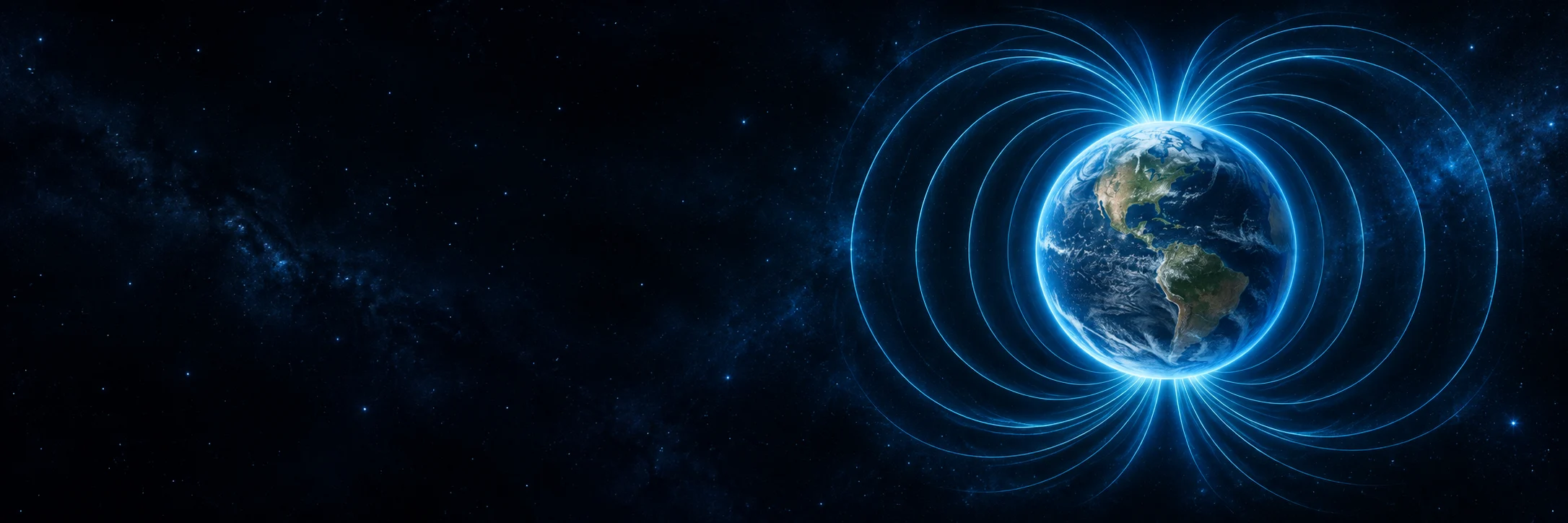
Physics V course sequence · Interactive lesson
Magnetic moments and Larmor precession
Couple a spin-half to a magnetic field and the two-state algebra pays off at once: one number γ turns spin into magnetism, the Hamiltonian collapses to n̂⋅σ, and the propagator closes in a single line. This is what precesses, what stays frozen, and why g is not 1.
UPV-10.08 · Lesson 8 of 9 in this unit. Position is not a completion score.Build the model
The field sets the axis; the algebra sets the rate.
The key idea
Larmor precession is the rigid rotation of a spin's expectation value ⟨S⟩ about the applied field, at angular rate ω = |γ|B, generated by the Zeeman Hamiltonian Ĥ = −γ B⋅Ŝ.
Example. An electron in B = 1.00 mT has |γ|B = 1.76 × 10⁸ rad s⁻¹, so ⟨S⟩ sweeps its cone once in 2π/ω = 35.7 ns — while the spinor itself needs 71.4 ns to return unchanged.
The complete physical model and assumptions
Two numbers fix this entire topic: the field magnitude B, and one constant per species. The projection theorem leaves a spin-half no freedom at all in how it can be magnetic, so that constant γ is the whole of what "which particle this is" means here, and the Hamiltonian it produces is the most general traceless Hermitian 2×2 matrix there is — which is why this one problem is simultaneously the general theory of a driven qubit. Two invariants then organise the motion. n̂⋅Ŝ commutes with Ĥ, so the populations along the field are frozen and the polar angle of ⟨S⟩ never opens or closes; only the azimuth runs, at ω = −γB, and it runs at that same rate whatever the tip angle. The half-angle sitting inside the propagator is the geometry of SU(2): one full 2π turn of ⟨S⟩ leaves the spinor at −1, and that sign is invisible to every single-spin probability but not to an interferometer. Three limits bound all of it. The cone is an ensemble mean and not a trajectory — each individual measurement still returns ±ħ/2. Nothing here relaxes: settling into alignment with B costs an environment, because evolution under this Ĥ preserves every population along B exactly. And γ is an input the formalism cannot manufacture; Dirac fixes gₛ = 2 for a structureless spin-half, and QED supplies the 0.00232 on top.
1μ̂ = γŜ is forced, not fitted
A magnetic moment is a vector operator, and inside a single spin-half multiplet there is only one vector operator to build it from: Ŝ itself. The projection theorem therefore forces μ̂ = γŜ, and every species-specific fact collapses into the single number γ. Classically a rigid body of charge q and mass m, with charge and mass identically distributed, gives μ = (q/2m)L — a g factor of exactly 1, and orbital motion in an atom does obey gₗ = 1. Spin does not: γ = −gₛ e/2mₑ with gₛ ≈ 2, so an electron is twice as magnetic as its angular momentum classically allows. That γ is an input rather than a derivation shows in the table of values: γₚ/2π = 42.577 MHz T⁻¹ for the proton, while the neutron, with no charge at all, still carries gₙ = −3.826.
2Diagonalise along B, never along the lab's z
Write B = B n̂ and the Zeeman Hamiltonian is Ĥ = −μ̂⋅B = −γB(n̂⋅Ŝ) = (ħω/2)(n̂⋅σ), with ω = −γB. That is a traceless Hermitian 2×2 matrix, so the spectrum is read straight off the eigenvalues ±1 of n̂⋅σ: energies ∓γħB/2 and a splitting ΔE = ħ|γ|B = gₛ μB B. The eigenbasis is the pair diagonalised in UPV-10.04 — |n,+⟩ = (cos(θ/2), e(iφ)sin(θ/2)) and |n,−⟩ = (−sin(θ/2), e(iφ)cos(θ/2)), two genuinely different spinors and not one formula with a sign buried in it. Watch the ordering: for the electron γ < 0, so E_± = ∓γħB/2 puts |n,+⟩, the state with ⟨S⟩ along B, at the higher energy +|γ|ħB/2. The choice of basis is the boundary condition here, and the field makes it: put B along x and Ŝₓ is what is conserved, while the laboratory's |↑⟩ and |↓⟩ become the superpositions. Numbers then set the technology. An electron at 0.339 T splits by h × 9.5 GHz — X-band microwaves in an ESR cavity. A proton at 1.5 T splits by h × 63.9 MHz — a radio coil. Both gaps are minute beside kT = 25.9 meV at 300 K, and how minute decides the experiment: the equilibrium polarisation tanh(ΔE/2kT) is 7.6 × 10⁻⁴ for that electron but only 5.1 × 10⁻⁶ for that proton, some 150 times smaller, which is why NMR works on a part-in-a-million population difference and lives on signal averaging.
3Exponentiate with the algebra: (n̂⋅σ)² = I
Nothing has to be integrated. Because (n̂⋅σ)² = I, every even power in the series for U(t) = exp(−iĤt/ħ) = exp(−i(ωt/2)(n̂⋅σ)) is I and every odd power is n̂⋅σ, so the series resums to U(t) = cos(ωt/2) I − i sin(ωt/2)(n̂⋅σ). That is exactly the SU(2) rotation operator with rotation angle ωt about n̂: evolving a spinor in a magnetic field is literally rotating it about the field direction, at rate ω = −γB. Two consequences follow from the half-angle. ⟨S⟩ returns after ωt = 2π, but U = −I there, so the state itself needs ωt = 4π; and that minus sign stops being global as soon as the spin is one arm of an interferometer, which is how neutron experiments measured the 4π period directly.
4What precesses, and what is frozen
Take B along z, so Ĥ = (ħω/2)σz, and start from |ψ(0)⟩ = cos(θ/2)|↑⟩ + sin(θ/2)|↓⟩. Then |ψ(t)⟩ = cos(θ/2)e(−iωt/2)|↑⟩ + sin(θ/2)e(+iωt/2)|↓⟩: the moduli are untouched, and only the relative phase runs, at ωt. So P(↑) = cos²(θ/2) and ⟨Sz⟩ = (ħ/2)cos θ are constants of the motion, which is just [Ĥ, Ŝz] = 0 restated. What moves is the transverse pair, ⟨Sₓ⟩ = ħ Re(α*β) = (ħ/2) sin θ cos ωt and ⟨Sy⟩ = ħ Im(α*β) = (ħ/2) sin θ sin ωt: fixed length, rotating azimuth. At θ = 60° the state keeps P(↑) = 0.750 for ever while ⟨S⟩ sweeps a cone of transverse radius 0.433ħ. Shifting population needs a field component perpendicular to z; on resonance a rotating B₁ tips the spin at rate γB₁ in the rotating frame, and that is the whole of pulsed NMR.
5Uniform field, or spin stops being separable
Every line above assumed B is the same across the wavepacket, so the state factorises as |spatial⟩ ⊗ |spin⟩. Let B depend on position and Ĥ = −γ B(r)⋅Ŝ becomes an entangler: the ↑ and ↓ components pick up different momenta, the packets separate, and the transverse components of ⟨S⟩ die as the overlap ⟨χ₊|χ₋⟩ goes to zero. That is Stern–Gerlach, and it is what measuring Sz physically consists of. The ensemble version is everyday: a spread ΔB across an NMR sample gives a spread of rates |γ|ΔB, and the transverse signal fans out over T₂* ≈ 1/(πΔf). Protons at 1.5 T with ΔB = 1.0 μT give Δf = 42.6 Hz and T₂* ≈ 7.5 ms — some 4.8 × 10⁵ precessions before the free-induction decay is gone. Because that dephasing is static, a π pulse reverses it and rebuilds an echo; only genuine T₂ processes survive.
6g = 2, and the parts per trillion after it
The Dirac equation for a point spin-half in a field predicts gₛ = 2 exactly — the first real explanation of the factor Uhlenbeck and Goudsmit had to insert by hand, and a decisive argument against any picture of the electron as spinning charged matter. Schwinger's one-loop correction adds aₑ = (gₛ − 2)/2 = α/2π = 1.1614 × 10⁻³; carried further, aₑ = α/2π − 0.3285(α/π)² + … = 1.15965 × 10⁻³, agreeing with experiment to about a part in 10¹². The measurement is exactly the physics of this topic: compare the spin-precession frequency with the cyclotron frequency of the same electron in the same field. Composite particles sit nowhere near 2 — gₚ = 5.586, gₙ = −3.826 — and the muon anomaly, measured the same way at Fermilab, is watched because a discrepancy there would be new physics.
Key equations
Read the units, assumptions and limits before substituting.
Moment and spin are one operator
μ̂ = γ Ŝ, γ = −gₛ e / 2mₑ = −gₛ μB / ħ
Inside one multiplet Ŝ is the only vector operator there is, so a single number carries every species-specific fact.
γ in rad s⁻¹ T⁻¹; μB = eħ/2mₑ = 9.274 × 10⁻²⁴ J T⁻¹; for the electron |γ|/2π = 28.025 GHz T⁻¹Zeeman Hamiltonian for B = B n̂
Ĥ = −μ̂⋅B = −γB (n̂⋅Ŝ) = (ħω/2)(n̂⋅σ), ω = −γB
The field, not the lab's z axis, fixes the energy eigenbasis: diagonalise along B before computing anything.
Eigenvalues ∓γħB/2 on the eigenspinors |n,±⟩; splitting ΔE = ħ|γ|B = gₛ μB B, in joulesClosed-form propagator
U(t) = e(−i ωt n̂⋅σ / 2) = cos(ωt/2) I − i sin(ωt/2)(n̂⋅σ)
One 2×2 matrix evolves any spinor to any time, with no series and no numerical integration.
Uses (n̂⋅σ)² = I, so even powers give I and odd powers give n̂⋅σ; ωt is dimensionlessPrecession of the mean, exact
d⟨S⟩/dt = γ ⟨S⟩ × B = ω × ⟨S⟩, ω = −γB
Ehrenfest closes exactly because Ĥ is linear in Ŝ, so the classical torque law returns with no approximation.
ω in rad s⁻¹ with |ω| = |γ|B; ⟨Sz⟩ is constant whenever B lies along zLarmor frequency in laboratory units
fL = |γ|B / 2π, ΔE = h fL
Turns a measured resonance line into a field reading — the basis of NMR, MRI and precision magnetometry.
Electron 28.025 GHz T⁻¹; proton 42.577 MHz T⁻¹; muon 135.5 MHz T⁻¹The g factor and its anomaly
aₑ = (gₛ − 2)/2 = α/2π − 0.3285(α/π)² + … = 1.15965 × 10⁻³
Comparing spin-precession with cyclotron frequency in one trap makes this the sharpest test of QED there is.
Dirac gives gₛ = 2 exactly; measured gₛ = 2.002 319 304 36; orbital motion has gₗ = 1Interactive lab
Predict first. Explore the model. Compare the result.
Explore the model
Try this. Advance t and watch the right-hand arrow sweep while the dashed chord on the left holds its height; then open θ and see the cone widen without changing the Larmor rate at all, which only B sets.
Live results
- LARMOR f = |γ|B/2π
- 28.02 MHz
- PRECESSION ANGLE ωt
- 121 °
- P(Sz = +ħ/2)
- 0.750
- ⟨Sz⟩ (frozen)
- 0.250 ħ
Results follow this lesson’s model and assumptions. Displayed values are rounded.
Predict → change one variable → check
Plan a change before running it. Every other input stays at the saved baseline.
Saved baseline. Tip angle θ from B: 60 °; Field B along z: 1.0 mT; Elapsed time t: 12.0 ns
This experiment is kept only while this page is open. It does not change saved course progress.
Catch the common trap
The commonest error is to read the cone literally and expect the spin to settle onto the field. Two things go wrong. First, the cone is a picture of ⟨S⟩ alone: a measurement along any axis still returns ±ħ/2, and with B along z the probability of +ħ/2 is cos²(θ/2) at every instant, because [Ĥ, Ŝz] = 0. Precession transfers no population, and unitary evolution never aligns a spin with B — T₁ relaxation is an environment absorbing energy, not part of this Hamiltonian. Second, ω = |γ|B is the rate of ⟨S⟩; the spinor turns at half that. After one full precession, ωt = 2π and U = −I: the state has changed sign while every single-spin probability is untouched.
Practice & worked examples
3 authored examples. Make an attempt, then reveal the reasoning one step at a time.
EasyExample 1
An electron sits in a uniform field of 0.500 T. Taking gₛ = 2.0023, μB = 9.274 × 10⁻²⁴ J T⁻¹ and ħ = 1.0546 × 10⁻³⁴ J s, find the gyromagnetic ratio, the Larmor frequency, the Zeeman splitting in joules and in μeV, and the time for ⟨S⟩ to complete one precession.
Sketch your answer or reasoning, then compare it with the authored solution. Your writing is not automatically graded or saved.
0 of 5 steps revealed.
- Gyromagnetic ratio from its definition: |γ| = gₛ e/2mₑ = gₛ μB/ħ = 2.0023 × 9.274 × 10⁻²⁴ / 1.0546 × 10⁻³⁴ = 1.761 × 10¹¹ rad s⁻¹ T⁻¹.
- Precession rate: ω = |γ|B = 1.761 × 10¹¹ × 0.500 = 8.804 × 10¹⁰ rad s⁻¹, so fL = ω/2π = 1.401 × 10¹⁰ Hz = 14.0 GHz — microwave, which is why ESR needs a cavity and not a coil.
- Splitting between the two eigenvalues ∓γħB/2: ΔE = ħ|γ|B = gₛ μB B = 2.0023 × 9.274 × 10⁻²⁴ × 0.500 = 9.28 × 10⁻²⁴ J.
- In electronvolts: 9.28 × 10⁻²⁴ / 1.602 × 10⁻¹⁹ = 5.80 × 10⁻⁵ eV = 58.0 μeV, some 450 times smaller than kT = 25.9 meV at 300 K, so the two levels are almost equally populated.
- ⟨S⟩ turns once per Larmor period: T = 1/fL = 2π/ω = 71.4 ps. The spinor itself needs ωt = 4π, that is 142.7 ps, before U returns to +I.
Answer. |γ| = 1.761 × 10¹¹ rad s⁻¹ T⁻¹; fL = 14.0 GHz; ΔE = 9.28 × 10⁻²⁴ J = 58.0 μeV. ⟨S⟩ precesses once in 71.4 ps, while the spinor returns only after 142.7 ps.
MediumExample 2
An electron is prepared with its spin along n̂ at θ = 60° from z, with φ = 0, in a uniform field B = 1.00 mT ẑ. Write the initial spinor, give P(Sz = +ħ/2) and ⟨Sz⟩, obtain ⟨Sₓ⟩(t) and ⟨Sy⟩(t), and evaluate them at t = 10.0 ns. Take |γ| = 1.761 × 10¹¹ rad s⁻¹ T⁻¹.
Sketch your answer or reasoning, then compare it with the authored solution. Your writing is not automatically graded or saved.
0 of 6 steps revealed.
- The state is the eigenspinor of n̂⋅σ with eigenvalue +1: |n,+⟩ = (cos(θ/2), e(iφ) sin(θ/2)) = (cos 30°, sin 30°) = (0.8660, 0.5000).
- Born rule in the z basis: P(↑) = 0.8660² = 0.750 and P(↓) = 0.250, so ⟨Sz⟩ = (ħ/2)(0.750 − 0.250) = ħ/4 = 2.64 × 10⁻³⁵ J s. Both are constants of the motion, since [Ĥ, Ŝz] = 0.
- Evolve with Ĥ = (ħω/2)σz, where ω = −γB = |γ|B for the electron: |ψ(t)⟩ = 0.8660 e(−iωt/2)|↑⟩ + 0.5000 e(+iωt/2)|↓⟩. The relative phase is ωt.
- Transverse means from α*β = 0.4330 e(+iωt): ⟨Sₓ⟩ = ħ Re(α*β) = 0.433ħ cos ωt and ⟨Sy⟩ = ħ Im(α*β) = 0.433ħ sin ωt — fixed length (ħ/2)sin 60°, rotating direction.
- Rate: ω = 1.761 × 10¹¹ × 1.00 × 10⁻³ = 1.761 × 10⁸ rad s⁻¹, so fL = 28.0 MHz and the precession period is 35.7 ns.
- At t = 10.0 ns: ωt = 1.761 rad = 100.9°, giving ⟨Sₓ⟩ = 0.433ħ cos 100.9° = −0.082ħ and ⟨Sy⟩ = 0.433ħ sin 100.9° = +0.425ħ. Their resultant is still 0.433ħ, as it must be.
Answer. P(↑) = 0.750 and ⟨Sz⟩ = ħ/4 at every instant. ⟨Sₓ⟩ = 0.433ħ cos ωt, ⟨Sy⟩ = 0.433ħ sin ωt with ω = 1.761 × 10⁸ rad s⁻¹; at 10.0 ns, ωt = 100.9°, so ⟨Sₓ⟩ = −0.082ħ and ⟨Sy⟩ = +0.425ħ.
HardExample 3
A pulsed-NMR sample of protons (γ/2π = 42.577 MHz T⁻¹) sits in B₀ = 1.500 T ẑ. A resonant field of amplitude B₁ = 0.500 mT rotates in the xy plane. Find the Larmor frequency, the duration of a π/2 pulse, and the free-induction-decay time T₂* if the field varies by ΔB = 1.00 μT across the sample, and say how many precessions fit inside it.
Sketch your answer or reasoning, then compare it with the authored solution. Your writing is not automatically graded or saved.
0 of 6 steps revealed.
- Larmor frequency: f₀ = (γ/2π)B₀ = 42.577 × 1.500 = 63.87 MHz, so ω₀ = 2π f₀ = 4.013 × 10⁸ rad s⁻¹ — the frequency the coil must be tuned to.
- Move to the frame rotating at ω₀ about z. On resonance the effective longitudinal field B₀ + ω/γ vanishes, leaving only the static B₁ along x′, so Ĥ′ = −γB₁ Ŝₓ′ generates a rotation about x′.
- Rabi rate: ω₁ = γB₁ = 2π × 42.577 × 10⁶ × 5.00 × 10⁻⁴ = 1.338 × 10⁵ rad s⁻¹, that is 21.3 kHz — three thousand times slower than the Larmor motion it rides on.
- A π/2 tip needs ω₁t = π/2, so t₉₀ = 1.5708 / 1.338 × 10⁵ = 1.17 × 10⁻⁵ s = 11.7 μs. It carries ⟨S⟩ from +z into the transverse plane, where it precesses at 63.87 MHz and induces the signal.
- Inhomogeneity spreads the rates: Δf = (γ/2π)ΔB = 42.577 × 10⁶ × 1.00 × 10⁻⁶ = 42.6 Hz. The moments fan out over T₂* ≈ 1/(πΔf) = 1/(π × 42.6) = 7.5 ms.
- Precessions inside that window: 63.87 × 10⁶ × 7.5 × 10⁻³ = 4.8 × 10⁵ turns. The dephasing is static, so a π pulse at time τ reverses it and rebuilds an echo at 2τ; only true T₂ survives that trick.
Answer. f₀ = 63.87 MHz; t₉₀ = 11.7 μs; T₂* ≈ 7.5 ms, during which the transverse moment turns about 4.8 × 10⁵ times before the free-induction decay dies away.
Quick check
Select an answer and explain it before checking.
Review & continue
Larmor precession is the rigid rotation of a spin's expectation value ⟨S⟩ about the applied field, at angular rate ω = |γ|B, generated by the Zeeman Hamiltonian Ĥ = −γ B⋅Ŝ.
- Explain the relationship without looking at the equation.
- Check a sign, a unit and a model assumption in your working.
- Return to the lab or worked example if a step is still unclear.