Nuclear, particle & quantum-information sequence · Interactive lesson
Magnetic confinement, MHD equilibrium and tokamaks
Two lessons of rates and Q-values now have to become a machine. Here you set the target — the n, T and τE a burning D–T plasma must reach — then answer the two questions every tokamak lives by with linear algebra: does an equilibrium exist, and will a small displacement of it grow?
UPV-16.08 · Lesson 8 of 9 in this unit. Position is not a completion score.Nuclear, particle & quantum-information sequence. These units continue into nuclear and particle physics and quantum information. Follow your university’s prerequisites, mathematical depth and assessment; this independent pathway is not a universal programme specification.
Build the model
Equilibrium is a boundary-value problem; stability is the sign of a quadratic form.
The key idea
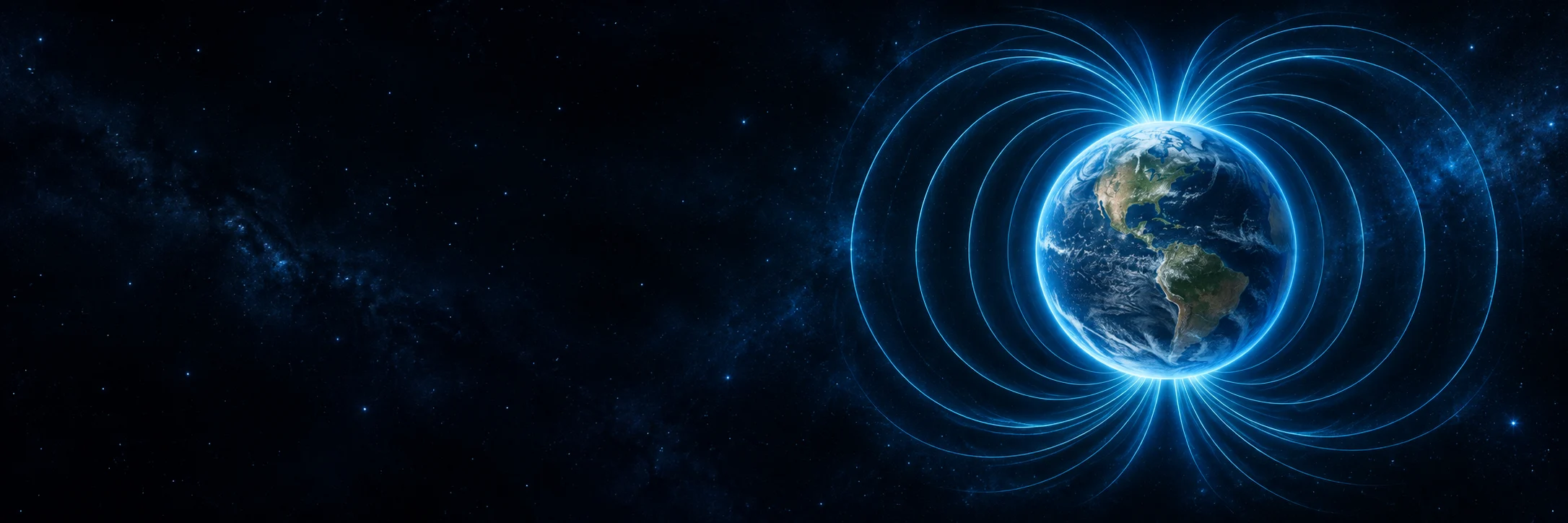
Magnetic confinement holds a fusion plasma by balancing its pressure gradient against the J × B force of a helical field; in a tokamak the axisymmetric equilibrium solves the Grad–Shafranov equation and its ideal-MHD stability is fixed by the sign of the energy δW.
Example. ITER: Iₚ = 15 MA inside a = 2.0 m gives Bθ(a) = μ₀Iₚ/2πa = 1.5 T against Bφ = 5.3 T, so the circular estimate of the field-line pitch is q = aBφ/RBθ = 1.14, lifted to q₉₅ ≈ 3 by the D-shaped cross-section — above the Kruskal–Shafranov kink limit q = 1.
The complete physical model and assumptions
Ideal magnetohydrodynamics treats the plasma as one conducting fluid with its field lines frozen in: momentum balance ρ dv/dt = J × B − ∇p, Ampère's law, and the ideal Ohm's law E + v × B = 0, obtained from moments of the kinetic equation when the gyroradius is small and collisions are frequent. Set v = 0 and the equilibrium is J × B = ∇p, which makes every magnetic surface an isobar; impose axisymmetry and the vector equation collapses to one scalar elliptic PDE for the poloidal flux ψ(R, Z) — the Grad–Shafranov equation — with the pressure and current profiles as free inputs and ψ = const on the last closed surface as its boundary condition. Linearise about that equilibrium and a displacement ξ obeys ρ∂²ξ/∂t² = F(ξ), where the force operator F is self-adjoint under ideal boundary conditions, exactly as a Hermitian Hamiltonian is, so ω² is real and the plasma can only oscillate or grow, never grow overstably. Stability therefore reduces to the sign of one quadratic form, δW = −½∫ξ*⋅F(ξ) dV, tested against every allowed ξ. That is what the model buys. What it costs is everything the ideal Ohm's law forbids: resistive tearing at rational surfaces, neoclassical islands, and the turbulence that actually sets τE — so the triple product the power balance demands, about 3 × 10²¹ keV s m⁻³, is a target the equilibrium can hold but cannot by itself promise to reach.
1Pressure balance, and why the torus needs a twist
A plasma at n = 10²⁰ m⁻³ and T = 10 keV has pressure p = 2nT = 2 × 10²⁰ × 10 × 1.602 × 10⁻¹⁶ J = 3.2 × 10⁵ Pa — three atmospheres at a hundred million kelvin, and no wall can touch it. Ideal MHD holds it with the field: at rest the momentum equation is J × B = ∇p, so B⋅∇p = 0 and J⋅∇p = 0 — pressure is constant on magnetic surfaces and the current flows within them. The field's own pressure is B²/2μ₀ = 11.2 MPa at 5.3 T, so the plasma uses only β = 2μ₀p/B² ≈ 2.9 % of it. A straight cylinder loses particles out of its ends, so bend it into a torus — but a purely toroidal field is not an equilibrium: its 1/R gradient and curvature drive ions and electrons vertically in opposite directions, the resulting E × B drift pushes the whole column outward, and nothing balances the hoop force. The cure is a poloidal component that winds each field line helically, so a particle's upward drift on one pass is cancelled on the next. A tokamak makes that poloidal field with the plasma's own toroidal current, which is why Iₚ is the number everything else scales with.
2Do the power balance: where 3 × 10²¹ comes from
Write the steady-state ledger per unit volume for a 50:50 D–T plasma with nD = nT = n/2 and Tₑ = Tᵢ = T. Alpha heating is (n²/4)⟨σv⟩Eα with Eα = 3.5 MeV; transport removes the stored energy 3nT once per confinement time, 3nT/τE; and the electrons radiate bremsstrahlung CB n²√T with CB = 5.35 × 10⁻³⁷ W m³ per √keV. Ignition — alpha heating alone sustaining the plasma — needs (n²/4)⟨σv⟩Eα ≥ 3nT/τE + CB n²√T. At T = 15 keV the Bosch–Hale value is ⟨σv⟩ = 2.74 × 10⁻²² m³/s, so the heating coefficient is ¼ × 2.74 × 10⁻²² × 5.61 × 10⁻¹³ J = 3.84 × 10⁻³⁵ W m³ against bremsstrahlung 2.07 × 10⁻³⁶ W m³, a 5.4 % tax. Then nτE ≥ 3 × 15 keV/[(3.84 − 0.21) × 10⁻³⁵ W m³] = 7.21 × 10⁻¹⁵ J/(3.63 × 10⁻³⁵ W m³) = 1.99 × 10²⁰ s m⁻³, and nTτE ≥ 3.0 × 10²¹ keV s m⁻³. Because ⟨σv⟩ ∝ T² between 10 and 20 keV, the T² in the numerator cancels and the requirement is nearly flat there; below about 4.3 keV bremsstrahlung outruns alpha heating at any density — the ideal ignition temperature. Every term here is bookkeeping of ⟨σv⟩ from the last two lessons; nothing in it is confinement physics yet.
3Reduce the equilibrium to one PDE on the poloidal plane
Axisymmetry does the work. Write B = ∇ψ × ∇φ + F∇φ, where ψ(R, Z) is the poloidal flux per radian and F = RBφ; ∇⋅B = 0 is then automatic. Because B⋅∇p = 0, p is a function of ψ alone, and J⋅∇p = 0 forces F = F(ψ) too. Substituting into J × B = ∇p and keeping the component along ∇ψ leaves one scalar equation, Δ*ψ = −μ₀R² p′(ψ) − FF′(ψ), where Δ* = R∂R(R⁻¹∂R) + ∂²Z is elliptic and carries the 1/R that distinguishes a torus from a cylinder. The unknown is ψ on the (R, Z) plane; the inputs are two profiles, p(ψ) and F(ψ), supplied by measurement, not by MHD; the boundary condition is ψ = ψb on the last closed flux surface — a limiter surface, or a separatrix whose X-point (∇ψ = 0) feeds the divertor. The right-hand side depends on the solution, so solve numerically: discretise Δ* on a grid, evaluate the source with the current ψ, invert the linear operator, repeat — the Picard loop equilibrium codes run between shots. One output is the Shafranov shift: the magnetic axis sits outboard of the geometric centre by about (a²/2R)(βₚ + lᵢ/2), roughly 0.35 m for ITER.
4Read the safety factor off the equilibrium
The equilibrium fixes how tightly each field line winds. On a surface of minor radius r a line makes q = rBφ/(RBθ) toroidal turns per poloidal turn in the large-aspect-ratio circular limit — q is the pitch, and it is the coordinate stability speaks in. At the edge, Ampère's law gives Bθ(a) = μ₀Iₚ/2πa, so qₐ = 2πa²Bφ/(μ₀RIₚ): more current unwinds the pitch, more toroidal field tightens it. For ITER, 15 MA in a = 2.0 m gives Bθ(a) = 1.5 T and qcyl = 2.0 × 5.3/(6.2 × 1.5) = 1.14; the D-shaped section with κ = 1.7 multiplies this by about (1 + κ²)/2 = 1.95, and toroidal corrections take q₉₅ to 3. Inside, q follows the current profile: for j ∝ (1 − r²/a²)ν the enclosed current gives q(r) = qₐ(r²/a²)/[1 − (1 − r²/a²)(ν+1)], so q₀ = qₐ/(ν + 1) — a parabolic profile puts the axis at half the edge value. Surfaces where q = m/n are rational: a helical perturbation with m poloidal and n toroidal periods lines up with the field there and bends no field lines, which is why those surfaces are where instabilities live. The figure below draws this profile.
5Test stability with a self-adjoint operator
Displace the equilibrium by ξ(r, t) and linearise. With p₁ = −ξ⋅∇p − γp∇⋅ξ and B₁ = ∇×(ξ×B) ≡ Q, the dynamics collapse to ρ∂²ξ/∂t² = F(ξ) with F(ξ) = J×Q + μ₀⁻¹(∇×Q)×B + ∇(ξ⋅∇p + γp∇⋅ξ). With n⋅ξ = 0 on a conducting wall, F is self-adjoint: ∫η⋅F(ξ) dV = ∫ξ⋅F(η) dV. For a normal mode ξe(−iωt), −ρω²ξ = F(ξ), so ω² = −∫ξ*⋅F(ξ) dV/∫ρ|ξ|² dV is real, exactly as ⟨ψ|H|ψ⟩/⟨ψ|ψ⟩ is real for Hermitian H. Two cases remain: ω² > 0 oscillates, ω² < 0 grows as e(γt) with γ = √(−ω²). Define δW = −½∫ξ*⋅F(ξ) dV; the plasma is stable if and only if δW ≥ 0 for every admissible ξ, and, by Rayleigh–Ritz, one trial ξ with δW < 0 proves instability outright. Written out, δW has three positive terms — field-line bending |Q⊥|²/μ₀, field compression, plasma compression γp|∇⋅ξ|² — against two that can be negative, the pressure gradient in bad curvature and the parallel current: interchange and ballooning modes tap the first, kinks the second. Numerically, discretising −F gives a symmetric matrix A and ρ a positive-definite M; Aξ = ω²Mξ has real eigenvalues, and the sign of the lowest is the test.
6Know what ideal MHD cannot see
The theorem's hypothesis is the ideal Ohm's law, which freezes field lines into the fluid and forbids any change of magnetic topology. Add resistivity η and the constraint fails in a thin layer at each rational surface, where field lines reconnect into islands. That is the tearing mode: it grows on the hybrid timescale τR³⁄⁵τA²⁄⁵, between the Alfvén time τA = a/vA and the resistive time τR = μ₀a²/η, and it is judged by Δ′, a matching condition across the layer, not by δW, because a topology-changing ξ was never in ideal MHD's trial space. Neoclassical tearing modes, driven by the bootstrap current lost inside an island, set the β actually reachable below the Troyon value. Two more limits are empirical: the Greenwald density limit nG = Iₚ/πa² (10²⁰ m⁻³ for Iₚ in MA, a in m), and τE itself, which comes from the IPB98(y,2) scaling of many machines, not from any equation here. The triple product is thus a target the equilibrium can hold and the ideal test can protect; whether τE reaches the 2 s the balance asks for at 10²⁰ m⁻³ is answered by turbulence and by experiment.
Key equations
Read the units, assumptions and limits before substituting.
D–T ignition power balance
¼n²⟨σv⟩Eα = 3nT/τE + CB n²√T ⇒ nTτE ≥ 12T²/(⟨σv⟩Eα) with bremsstrahlung dropped
At 15 keV, ⟨σv⟩ = 2.74 × 10⁻²² m³/s gives 2.8 × 10²¹ keV s m⁻³, and 3.0 × 10²¹ once bremsstrahlung takes its 5 % — the number every device is measured against.
n in m⁻³, T in keV, τE in s, ⟨σv⟩ in m³/s, Eα = 3500 keV; CB = 5.35 × 10⁻³⁷ W m³ per √keV, so convert the keV terms at 1.602 × 10⁻¹⁶ J/keV before adding itIdeal-MHD equilibrium and β
J × B = ∇p, B⋅∇p = 0, J⋅∇p = 0β = 2μ₀⟨p⟩/B²
Magnetic surfaces are isobars that also carry the current. β says what fraction of the field's pressure the plasma uses — a few per cent — and fusion power goes as β²B⁴.
J in A m⁻², p in Pa, B in T, μ₀ = 4π × 10⁻⁷ H/m; the field's own pressure B²/2μ₀ is 11.2 MPa at 5.3 TGrad–Shafranov equation
Δ*ψ ≡ R ∂R(R⁻¹ ∂Rψ) + ∂²Zψ = −μ₀R² p′(ψ) − F F′(ψ)
One nonlinear elliptic PDE on the poloidal plane replaces the vector force balance. Discretise Δ* on an (R, Z) grid and Picard-iterate the right-hand side to convergence.
ψ(R, Z) is poloidal flux per radian in Wb; F = RBφ in T m; p(ψ), F(ψ) are inputs; ψ = const on the boundarySafety factor and the tokamak's numbers
q ≈ rBφ/(RBθ), Bθ(a) = μ₀Iₚ/(2πa), qₐ = 2πa²Bφ/(μ₀RIₚ)
ITER: Bθ(a) = 1.5 T, qcyl = 1.14, q₉₅ ≈ 3. A rational surface q = m/n is where an (m, n) helical perturbation lines up with the field and can resonate.
r, a, R in m, B in T, Iₚ in A; large aspect ratio, circular section; elongation κ multiplies qₐ by about (1 + κ²)/2Energy principle
ρω²ξ = −F(ξ), δW = −½∫ξ*⋅F(ξ) dV, ω² = δW/K, K = ½∫ρ|ξ|² dV
Self-adjoint means ω² is real: a mode oscillates or grows, never both. Stable if and only if δW ≥ 0 for every admissible ξ; one negative trial value proves instability.
ξ in m, δW in J, K in kg m², ω² in s⁻²; F is self-adjoint when n⋅ξ = 0 on a perfectly conducting wallKruskal–Shafranov and Troyon limits
qₐ > 1 for the m = n = 1 kinkβₘₐₓ(%) = βN Iₚ(MA)/[a(m) Bφ(T)], βN ≈ 2.8
Both come from the sign of δW. ITER at 15 MA, 2.0 m, 5.3 T: βₘₐₓ ≈ 4.0 %, and its 500 MW design point sits at βN ≈ 1.8, well inside.
flat-current cylinder: the (m, n) external kink is unstable for m − 1 < nqₐ < mInteractive lab
Predict first. Explore the model. Compare the result.
Explore the model
Try this. Raise Iₚ from 2.5 to 6 MA at 3.4 T: the curve slides down rigidly, q₀ crosses 1 near 2.8 MA (sawteeth) and qₐ near 5.7 MA (external kink) while Troyon's β limit climbs from 2.1 % to 4.9 %. Then raise ν at fixed Iₚ: qₐ stays put while the core drops — the internal kink is about the profile, not the current.
Live results
- EDGE qₐ = 2πa²Bφ/μ₀RIₚ
- 2.27
- AXIS q₀ = qₐ/(ν + 1)
- 1.13
- TROYON βₘₐₓ, βN = 2.8
- 2.1 %
- GREENWALD nG = Iₚ/πa²
- 0.80 10²⁰ m⁻³
Results follow this lesson’s model and assumptions. Displayed values are rounded.
Predict → change one variable → check
Plan a change before running it. Every other input stays at the saved baseline.
Saved baseline. Plasma current Iₚ: 2.50 MA; Toroidal field Bφ: 3.4 T; Current peaking ν: 1.0
This experiment is kept only while this page is open. It does not change saved course progress.
Catch the common trap
Students read 'the force operator is self-adjoint, so ω² is real' as a stability guarantee, because Hermitian sounds like well-behaved. It is the opposite of a guarantee: real ω² includes ω² < 0, which is pure exponential growth with γ = √(−ω²). What self-adjointness rules out is only overstability — complex ω, a mode that grows while it oscillates — and that is precisely what lets the sign of δW alone decide. The matching mistake runs the other way: taking δW > 0 for every ideal displacement to mean the tokamak is stable. The theorem is silent about any ξ that changes field topology, since the ideal Ohm's law forbids it, so the resistive tearing mode was never in the trial space; it is judged by Δ′ at the rational surface, and a discharge that passes every ideal test can still disrupt.
Practice & worked examples
3 authored examples. Make an attempt, then reveal the reasoning one step at a time.
EasyExample 1
ITER carries Iₚ = 15 MA in a plasma of minor radius a = 2.0 m and major radius R = 6.2 m with Bφ = 5.3 T on axis. Find Bθ at the edge, the circular-cylinder safety factor qₐ, and the value after the elongation correction (1 + κ²)/2 for κ = 1.7.
Sketch your answer or reasoning, then compare it with the authored solution. Your writing is not automatically graded or saved.
0 of 4 steps revealed.
- Ampère's law around the edge: Bθ(a) = μ₀Iₚ/(2πa) = 2 × 10⁻⁷ × 1.5 × 10⁷/2.0 = 1.5 T — about 28 % of the toroidal field, so the field lines are only gently helical.
- qₐ = aBφ/(RBθ) = 2.0 × 5.3/(6.2 × 1.5) = 10.6/9.3 = 1.14. The same number comes from qₐ = 2πa²Bφ/(μ₀RIₚ) = 2π × 4.0 × 5.3/(4π × 10⁻⁷ × 6.2 × 1.5 × 10⁷).
- Shaping: (1 + κ²)/2 = (1 + 2.89)/2 = 1.945, so q* = 1.14 × 1.945 = 2.22. Toroidal and triangularity corrections push the quoted q₉₅ to about 3.0.
- Circular, the same current would sit at qₐ = 1.14, uncomfortably near the Kruskal–Shafranov limit qₐ = 1 — the D shape is what lets ITER carry 15 MA.
Answer. Bθ(a) = 1.5 T, qₐ = 1.14 for a circular section, q* ≈ 2.2 with elongation; the operating q₉₅ ≈ 3.
MediumExample 2
For a 50:50 D–T plasma at T = 15 keV take ⟨σv⟩ = 2.74 × 10⁻²² m³/s, Eα = 3.5 MeV and bremsstrahlung Pbr = CB n²√T with CB = 5.35 × 10⁻³⁷ W m³ per √keV. Find the ignition condition on nτE and on nTτE, and the confinement time required at n = 1.0 × 10²⁰ m⁻³.
Sketch your answer or reasoning, then compare it with the authored solution. Your writing is not automatically graded or saved.
0 of 5 steps revealed.
- Alpha heating per unit volume is (n²/4)⟨σv⟩Eα. Convert Eα: 3.5 × 10⁶ × 1.602 × 10⁻¹⁹ = 5.61 × 10⁻¹³ J, so the coefficient of n² is ¼ × 2.74 × 10⁻²² × 5.61 × 10⁻¹³ = 3.84 × 10⁻³⁵ W m³.
- Bremsstrahlung coefficient of n²: 5.35 × 10⁻³⁷ × √15 = 2.07 × 10⁻³⁶ W m³, which is 5.4 % of the alpha heating — net heating coefficient 3.63 × 10⁻³⁵ W m³.
- Stored energy is 3nT = 3n × 15 × 1.602 × 10⁻¹⁶ J = 7.21 × 10⁻¹⁵ n J; ignition needs it replaced within τE: 3.63 × 10⁻³⁵ n² ≥ 7.21 × 10⁻¹⁵ n/τE, so nτE ≥ 1.99 × 10²⁰ s m⁻³.
- Multiply by T: nTτE ≥ 15 × 1.99 × 10²⁰ = 3.0 × 10²¹ keV s m⁻³. Dropping bremsstrahlung would have given 12T²/(⟨σv⟩Eα) = 12 × 225/(2.74 × 10⁻²² × 3500) = 2.8 × 10²¹.
- At n = 1.0 × 10²⁰ m⁻³, τE ≥ 1.99 × 10²⁰/10²⁰ = 2.0 s — the confinement time the machine, not the power balance, has to deliver.
Answer. nτE ≥ 2.0 × 10²⁰ s m⁻³ and nTτE ≥ 3.0 × 10²¹ keV s m⁻³; at 10²⁰ m⁻³ the plasma needs τE ≈ 2.0 s.
HardExample 3
Apply the Troyon limit βₘₐₓ(%) = βN Iₚ/(aBφ) with βN = 2.8 to ITER (15 MA, a = 2.0 m, Bφ = 5.3 T). Find the maximum pressure, the temperature it permits at n = 1.0 × 10²⁰ m⁻³, and the flat-profile D–T fusion power density there, given ⟨σv⟩(13.8 keV) = 2.35 × 10⁻²² m³/s and Efus = 17.6 MeV. Then use Pfus/V ∝ β²B⁴ to compare a 12 T device at the same β.
Sketch your answer or reasoning, then compare it with the authored solution. Your writing is not automatically graded or saved.
0 of 5 steps revealed.
- βₘₐₓ = 2.8 × 15/(2.0 × 5.3) = 42/10.6 = 3.96 %. The field pressure is B²/2μ₀ = 5.3²/(2 × 4π × 10⁻⁷) = 1.118 × 10⁷ Pa, so pₘₐₓ = 0.0396 × 1.118 × 10⁷ = 4.43 × 10⁵ Pa.
- With nₑ = nᵢ = n and equal temperatures, p = 2nT, so T = pₘₐₓ/(2n) = 4.43 × 10⁵/(2 × 10²⁰) = 2.21 × 10⁻¹⁵ J = 13.8 keV — the β limit caps the temperature a given density can hold.
- Fusion power density: (n²/4)⟨σv⟩Efus = 2.5 × 10³⁹ × 2.35 × 10⁻²² × (17.6 × 10⁶ × 1.602 × 10⁻¹⁹ J) = 2.5 × 10³⁹ × 2.35 × 10⁻²² × 2.82 × 10⁻¹² = 1.66 × 10⁶ W m⁻³, or 1.7 MW m⁻³.
- Across ITER's 830 m³ that flat-profile ceiling is about 1.4 GW. The 500 MW design point sits at βN ≈ 1.8; since P ∝ β² at fixed B, (1.8/2.8)² × 1.4 GW ≈ 0.57 GW — consistent, and it shows ITER runs well inside its ideal-MHD limit.
- Because ⟨σv⟩ ∝ T² near 15 keV, P/V ∝ n²T² ∝ p² ∝ (βB²)². At fixed β a 12 T field gives (12/5.3)⁴ = 26 times the power density, so the same power needs 1/26 of the volume — the whole case for high-field, small tokamaks.
Answer. pₘₐₓ = 4.4 × 10⁵ Pa (β = 4.0 %), T = 13.8 keV at 10²⁰ m⁻³, Pfus/V ≈ 1.7 MW m⁻³; at fixed β, 12 T buys a factor 26 in power density.
Quick check
Select an answer and explain it before checking.
Review & continue
Magnetic confinement holds a fusion plasma by balancing its pressure gradient against the J × B force of a helical field; in a tokamak the axisymmetric equilibrium solves the Grad–Shafranov equation and its ideal-MHD stability is fixed by the sign of the energy δW.
- Explain the relationship without looking at the equation.
- Check a sign, a unit and a model assumption in your working.
- Return to the lab or worked example if a step is still unclear.