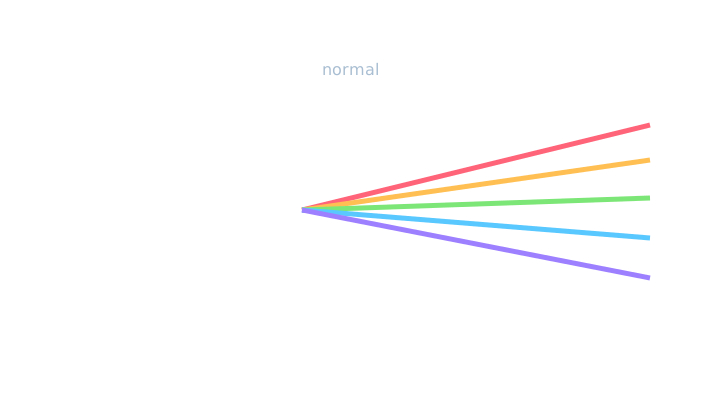
Build light one idea at a time.
Start with the foundations, then explore advanced ideas and calculus at the depth your course needs.
6 of 6 lessons
The Nature of Light
Connect rays, wavefronts, straight-line travel, and the inverse-square law.
Reflection
Use equal angles at the normal and construct plane-mirror images.
Refraction & Snell's Law
Explain bending through speed change, refractive index, and apparent depth.
Total Internal Reflection
Find critical angles and explain optical fibres.
Colour & Dispersion
Use prisms, rainbows, filters, and selective reflection.
Light Calculus
Use stationary travel time to recover ray laws and inverse-square sensitivity.
Change one variable. Watch the physics respond.
Explore n₁sinθ₁ = n₂sinθ₂, then take the idea into the full lessons.
Bend a light ray
First medium fixed at n₁ = 1.00. Entering the higher-index medium bends the ray toward the normal.
Everything around the chapter, in one place.
Keep building with practice, classroom presentations, formulae, and a game that puts these ideas to work.
Exam practice
Questions, guided reasoning, and exam-style problem solving.
Browse exam questions →Formula toolkit
Keep the key relationships and their units close to hand.
Review formulae →Members · Classroom presentationClassroom slides
Reveal lesson ideas, examples, and checks in full-screen classroom mode.
Open slides →Lesson files
Find downloadable teaching resources and worksheets in the library.
View files →Laser Maze
n₁sinθ₁ = n₂sinθ₂. Turn the launch angle and swap media to steer a beam onto its detector.
Play the free chapter game →See it. Read it. Work it.
Connect diagrams to physical relationships and exam reasoning.
Explore diagrams →Guided support
Ask for a hint, check your reasoning, or explore a similar problem.
Ask GioAI →Key ideas to remember
Visual reference & diagrams
Exam diagrams for this topic2 figures to inspect and practiseQuestions, hints and marking points in one compact subsection.
See it. Read it. Work it.
These figures come from GioPhysics practice papers. Open one, decode the drawing, work the guided questions, then follow its link to the full paper question.
- 01
InspectRead the figure comment.
- 02
TraceFollow labels, arrows and axes.
- 03
AnswerWork one part at a time.
- 04
CheckReveal hints and marking points.
IGCSE
01Fig. 8.1LightIGCSE
Figure comment
Fig. 8.1A straight length of optical fibre drawn in section as a long horizontal band with parallel walls, shaded to show glass and labelled glass core, n = 1.50, with air labelled outside it. Light entering the flat left-hand end travels up to the upper wall, reflects down to the lower wall, reflects again up to the upper wall and reaches the far end, giving a zig-zag path along the fibre. At one reflection a dashed normal is drawn perpendicular to the wall, and the angle on each side of it is marked with an arc; no angle is given a numerical value.
Read the comment once, then trace every arrow, label, axis or component in the drawing before opening the questions.
Guided questions 5 parts
Reading cue. The dashed normal is perpendicular to the fibre wall, so light running nearly along the fibre strikes that wall at a large angle close to 90°, not at a small one.
aState State how the two angles marked at the reflection in Fig. 8.1 compare with each other, and state the line from which each is measured.
Check answer 2 marks
- the two angles are equal, since the angle of incidence equals the angle of reflection
- both are measured from the normal drawn perpendicular to the wall of the core
bDetermine The core drawn in Fig. 8.1 is replaced by one of refractive index 1.60. Determine the critical angle for the new core, and state whether total internal reflection will now occur for a wider or a narrower range of angles.
Check answer 3 marks
- sin C = 1/1.60 = 0.625
- C = 39° (38.7°)
- the critical angle is smaller than for the 1.50 core, so a wider range of angles exceeds it and gives total internal reflection
cDetermine Light travels at 3.0 × 10⁸ m/s in air. Determine the speed of light inside the core labelled in Fig. 8.1, and the time taken for light to travel 1.0 km along a straight fibre if it runs along the axis without reflecting.
Check answer 3 marks
- v = c/n = 3.0 × 10⁸ / 1.50 = 2.0 × 10⁸ m/s
- t = d/v = 1000 / (2.0 × 10⁸)
- t = 5.0 × 10⁻⁶ s (5.0 μs)
dExplain Fig. 8.1 shows the light following a zig-zag path rather than running straight along the middle of the core. Explain why a short pulse of light sent into a long fibre arrives at the far end spread out over a longer time than it was sent, and state what this places a limit on.
Check answer 4 marks
- light following the zig-zag path travels a greater distance along the fibre than light running along the axis
- all of the light travels at the same speed, 2.0 × 10⁸ m/s, in the glass, so the zig-zag light arrives later than the axial light
- the pulse therefore arrives stretched out in time
- this limits how closely pulses may be sent one after another, and so how much information the fibre can carry each second
Transfer challenge
A prism in a periscope turns light through 90° by reflection at one face, the light meeting that face at 45° to the normal. Explain why the reflection is total for a prism of refractive index 1.50 but fails for one made of a plastic of refractive index 1.35.
Check answer 3 marks
- for the glass, sin C = 1/1.50 gives C = 41.8°, and 45° is greater than this, so the light is totally internally reflected
- for the plastic, sin C = 1/1.35 gives C = 47.8°
- 45° is less than 47.8°, so the light is refracted out through the face instead of being reflected, and the periscope fails
02Fig. 10.1LightIGCSE
Figure comment
Fig. 10.1The rectangular glass block drawn on the paper, seen from above. A ray labelled incident ray comes down from the upper left and meets the top face of the block; a dashed normal is drawn perpendicular to that face at the point where the ray strikes it. The angle between the incident ray and the normal is labelled i, and the angle between the normal and the ray travelling inside the glass is labelled r. The ray crosses the block, leaves through the bottom face and continues as the emergent ray. The optical pins are not shown.
Read the comment once, then trace every arrow, label, axis or component in the drawing before opening the questions.
Guided questions 5 parts
Reading cue. Both i and r are measured from the dashed normal, never from the block face, and r is the angle inside the glass, so r is always the smaller of the pair.
aState State how the direction of the emergent ray in Fig. 10.1 compares with that of the incident ray, and give a reason.
Check answer 2 marks
- the emergent ray is parallel to the incident ray, though shifted sideways from it
- the top and bottom faces are parallel, so the ray bends away from the normal on leaving by the same angle as it bent towards the normal on entering
bCalculate The block in Fig. 10.1 has a refractive index of 1.50 and the angle i is set to 40°. Calculate the angle r.
Check answer 2 marks
- sin r = sin i / n = sin 40° / 1.50 = 0.429
- r = 25° (25.4°)
cDetermine On the drawing the angle i measures 40° and the angle r measures 25°, each read to the nearest degree. Determine the largest and the smallest values of the refractive index consistent with these two readings.
Show a hint
Pair the extremes the right way round: a ratio is largest when its top is largest at the same time as its bottom is smallest.
Check answer 3 marks
- largest value uses the largest i with the smallest r: sin 40.5° / sin 24.5° = 1.57
- smallest value uses the smallest i with the largest r: sin 39.5° / sin 25.5° = 1.48
- the refractive index therefore lies between 1.48 and 1.57
dSuggest Suggest which of the two angles marked in Fig. 10.1 does more to limit the precision of the refractive index obtained, and justify your answer.
Check answer 3 marks
- the angle of refraction r limits it more
- r is the smaller angle, so the same reading error of half a degree is a larger fraction of r, and changes sin r by proportionally more than the same error changes sin i
- r is also not measured directly: it is drawn between the normal and a line joining the entry and exit points, so errors in the outline drawn round the block and in the marked emergent ray feed into it as well
Transfer challenge
A ray of light inside a glass block of refractive index 1.50 meets the surface at 30° to the normal from within the glass. Calculate the angle at which it leaves the glass, and state what happens instead if that internal angle is increased to 45°.
Check answer 3 marks
- sin θ(air) = 1.50 × sin 30° = 0.750
- θ(air) = 49° (48.6°)
- at 45° the ray exceeds the critical angle of 41.8°, so it is totally internally reflected and no light emerges from that face
Move without losing your place.
Extra challenging questions
Take the ideas further with course-specific extension questions, supplied-data graphs and worked solutions.