Build momentum one idea at a time.
Start with the foundations, then explore advanced ideas and calculus at the depth your course needs.
6 of 6 lessons
Linear Momentum
Connect mass, signed velocity, direction, and reference frames.
Impulse & Force–Time Graphs
Read impulse as momentum change and signed graph area.
Conservation of Momentum
Choose a system and balance momentum before and after an interaction.
Centre of Mass & Linear Collisions
Follow the system centre and compare elastic and inelastic outcomes.
Two-Dimensional Collisions
Resolve non-collinear momentum into independent horizontal and vertical balances.
Momentum Calculus Integration
Differentiate momentum for force and integrate force for impulse.
Change one variable. Watch the physics respond.
Explore p = mv, then take the idea into the full lessons.
Build momentum
The sign comes from velocity, so momentum keeps direction.
Everything around the chapter, in one place.
Keep building with practice, classroom presentations, formulae, and a game that puts these ideas to work.
Exam practice
Questions, guided reasoning, and exam-style problem solving.
Browse exam questions →Formula toolkit
Keep the key relationships and their units close to hand.
Review formulae →Members · Classroom presentationClassroom slides
Reveal lesson ideas, examples, and checks in full-screen classroom mode.
Open slides →Lesson files
Find downloadable teaching resources and worksheets in the library.
View files →Orbital Dock
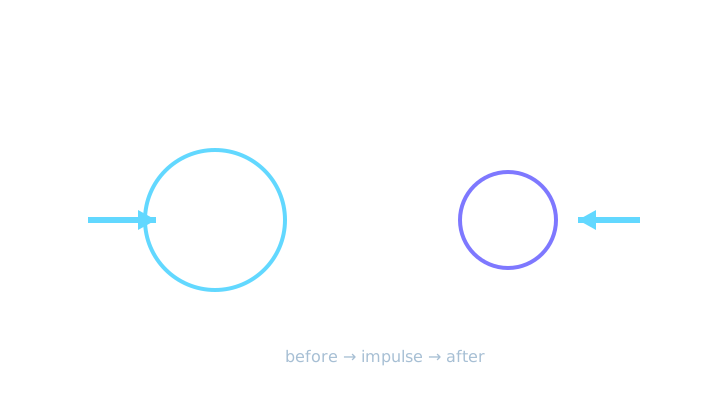
J⃗ = Δp⃗. Tune a vector impulse until two orbital capsules dock safely.
Play the free chapter game →See it. Read it. Work it.
Connect diagrams to physical relationships and exam reasoning.
Explore diagrams →Guided support
Ask for a hint, check your reasoning, or explore a similar problem.
Ask GioAI →Key ideas to remember
The standard term is two-dimensional or non-collinear momentum. Momentum still follows p = mv; the advanced step is conserving its x and y components separately.
Visual reference & diagrams
Exam diagrams for this topic3 figures to inspect and practiseQuestions, hints and marking points in one compact subsection.
See it. Read it. Work it.
These figures come from GioPhysics practice papers. Open one, decode the drawing, work the guided questions, then follow its link to the full paper question.
- 01
InspectRead the figure comment.
- 02
TraceFollow labels, arrows and axes.
- 03
AnswerWork one part at a time.
- 04
CheckReveal hints and marking points.
AP
01Fig. 4.1Linear MomentumAP
Figure comment
Fig. 4.1Two balls of equal size rest on a straight horizontal track, well apart from one another. The left-hand ball is labelled 0.50 kg and carries a horizontal arrow drawn from its centre pointing to the right, labelled 4.0 m/s. The right-hand ball is labelled 1.5 kg and carries a horizontal arrow drawn from its centre pointing to the left, labelled 2.0 m/s, so the two arrows point towards each other along the same line. A note on the figure states that this is the instant just before the collision.
Read the comment once, then trace every arrow, label, axis or component in the drawing before opening the questions.
Guided questions 5 parts
Reading cue. The labels are speeds, not velocities — direction is carried only by the arrowheads — so fix a positive direction along the track before you write down a single momentum.
aCalculate Calculate the total kinetic energy of the two balls at the instant drawn.
Check answer 2 marks
- ½(0.50)(4.0)² = 4.0 J and ½(1.5)(2.0)² = 3.0 J
- total = 7.0 J, with the directions of the arrows playing no part because kinetic energy is a scalar
bDetermine Determine the speed the 1.5 kg ball would need, with its direction of travel unchanged, for the total momentum of the pair to be zero.
Check answer 3 marks
- momentum of the 0.50 kg ball = 0.50 × 4.0 = 2.0 kg m/s to the right
- for zero total the 1.5 kg ball must carry 2.0 kg m/s to the left
- v = 2.0/1.5 = 1.3 m/s, slower than the 2.0 m/s marked on the figure
cDetermine The collision is in fact perfectly elastic rather than sticking. Determine the velocity of each ball immediately afterwards.
Show a hint
Two conservation statements give two equations. The quickest route is the elastic-collision result that the balls separate as fast as they approached — read the approach speed straight off the two arrows.
Check answer 4 marks
- momentum: 0.50v₁ + 1.5v₂ = 0.50(4.0) + 1.5(−2.0) = −1.0 kg m/s
- kinetic energy after must equal the 7.0 J before, or equivalently the separation speed equals the 6.0 m/s approach speed
- solving gives v₁ = −5.0 m/s for the 0.50 kg ball, that is 5.0 m/s to the left
- v₂ = +1.0 m/s for the 1.5 kg ball, that is 1.0 m/s to the right
dExplain Explain why the two arrows drawn on the figure cannot by themselves tell you whether the collision that follows is elastic, and describe one measurement made afterwards that would settle it.
Check answer 3 marks
- the figure fixes only the masses and the velocities before contact, and an elastic and an inelastic collision start from exactly the same drawn state
- momentum is conserved either way, so the total 1.0 kg m/s to the left is no test of elasticity
- measuring both final speeds and comparing the total kinetic energy after with the 7.0 J before decides it: equal means elastic, less means kinetic energy was lost
Transfer challenge
A 2.0 kg trolley is at rest on the same track with a compressed spring inside it. The spring is released and the trolley splits into a 0.50 kg piece that moves off at 4.0 m/s and a 1.5 kg piece. Determine the velocity of the 1.5 kg piece and the energy that had been stored in the spring.
Check answer 4 marks
- total momentum before is zero, so 0.50(4.0) + 1.5v = 0
- v = −1.3 m/s, that is 1.3 m/s in the opposite direction to the lighter piece
- kinetic energy after = ½(0.50)(4.0)² + ½(1.5)(1.33)² = 4.0 + 1.3 J
- the spring stored 5.3 J, since the system began with no kinetic energy
IB
02Figure 1Forces and momentumIB
Figure comment
Figure 1A graph of force F / N against time t / s on gridded axes, the force axis marked 0 to 40 N and the time axis 0 to 0.20 s. The plotted line rises straight from the origin to 40 N at t = 0.10 s and falls straight back to zero at t = 0.20 s, so the trace is a triangle standing on the time axis.
Read the comment once, then trace every arrow, label, axis or component in the drawing before opening the questions.
Guided questions 5 parts
Reading cue. The area under the triangle is the impulse; 40 N is the peak value at one instant, not a force that acts throughout, so nothing on this graph may simply be multiplied by 0.20 s.
aState State the magnitude of the resultant force acting at t = 0.050 s.
Check answer 2 marks
- reads the rising straight line halfway between the origin and the peak
- F = 20 N
bSketch The object has mass 0.50 kg. Sketch the acceleration-time graph for the same 0.20 s, marking values on both axes.
Check answer 3 marks
- same triangular shape: straight rise from the origin, straight fall to zero at t = 0.20 s
- peak acceleration = 40 / 0.50 = 80 m s⁻² at t = 0.10 s
- axes labelled a / m s⁻² and t / s with 80, 0.10 and 0.20 marked
cDetermine Determine the impulse delivered during the first 0.10 s, and hence determine the time at which the object, starting from rest, is moving at half of its final speed.
Check answer 3 marks
- impulse to t = 0.10 s = ½ × 0.10 × 40 = 2.0 N s
- total impulse = ½ × 0.20 × 40 = 4.0 N s, so exactly half the momentum has been delivered by the peak
- mass is constant and the object started from rest, so half the momentum is half the speed: t = 0.10 s
dDetermine The same force pulse is now applied to a 0.50 kg object already moving at 8.0 m s⁻¹ in the direction opposite to the force. Determine its velocity at t = 0.20 s, and explain why the same area under the graph still applies.
Check answer 4 marks
- area under the graph = ½ × 0.20 × 40 = 4.0 N s
- impulse gives the change in momentum, so Δv = 4.0 / 0.50 = 8.0 m s⁻¹ in the direction of the force
- taking the force direction as positive, v = −8.0 + 8.0 = 0, so the object is momentarily at rest
- the area fixes the change in velocity only, and is independent of the velocity the object started with
Transfer challenge
A tennis ball of mass 58 g is struck from rest and leaves the racket at 25 m s⁻¹. Contact lasts 5.0 ms and the force-time graph is again a symmetric triangle. Determine the peak force on the ball.
Check answer 4 marks
- impulse required = mΔv = 0.058 × 25 = 1.45 N s
- area of the triangle = ½ × 5.0 × 10⁻³ × F_peak
- F_peak = 2 × 1.45 / (5.0 × 10⁻³) = 580 N
- notes this is about 1000 times the ball's weight of 0.57 N, which is why the weight is ignored during contact
03Figure 3Kinematics · Forces and momentumIB
Figure comment
Figure 3Side view. A building stands on level hatched ground, its height marked by a dimension line labelled 25 m running from roof level down to the ground. A small ball, labelled as having mass 0.150 kg, sits at the right-hand edge of the roof, and a horizontal arrow from the ball labelled 12 m s⁻¹ points away from the building. A faint dashed curve traces the path the ball follows from the roof edge down to the ground.
Read the comment once, then trace every arrow, label, axis or component in the drawing before opening the questions.
Guided questions 5 parts
Reading cue. The 12 m s⁻¹ arrow is horizontal and is the whole initial velocity, so the ball leaves the roof with zero vertical speed and 25 m is a free-fall drop, not a length of the dashed curve.
aState State the horizontal component of the ball's velocity at the instant it reaches the ground, and give a reason.
Check answer 2 marks
- 12 m s⁻¹
- no horizontal force acts while air resistance is negligible, so the horizontal component is unchanged throughout
bDetermine Determine the horizontal distance from the foot of the building to the point where the dashed path meets the ground.
Check answer 3 marks
- vertical: 25 = ½ × 9.81 × t², so t = 2.26 s
- horizontal motion is at constant velocity: x = 12 × 2.26
- x = 27 m
cDetermine Determine the angle below the horizontal at which the dashed path meets the ground.
Check answer 3 marks
- vertical component on landing: v_y = 9.81 × 2.26 = 22.1 m s⁻¹
- horizontal component is still 12 m s⁻¹, so tan θ = 22.1 / 12 = 1.85
- θ = 62° below the horizontal
dDiscuss A second ball is thrown horizontally from the same point at 24 m s⁻¹. Discuss how its time of flight, its landing distance and its landing angle each compare with those of the first ball.
Check answer 4 marks
- the vertical motion is unaffected by the horizontal velocity, so the time of flight is the same, 2.26 s
- the landing distance doubles to 54 m, since x = ut with the same t
- the vertical component on landing is still 22.1 m s⁻¹, so tan θ = 22.1 / 24 and θ = 43°
- concludes that throwing harder flattens the path and moves the landing point out, but does not keep the ball in the air any longer
Transfer challenge
A stone is released from a hot-air balloon that is rising steadily at 4.0 m s⁻¹ when it is 25 m above the ground. Determine the time the stone takes to reach the ground.
Check answer 4 marks
- the stone shares the balloon's velocity, so it leaves with u = 4.0 m s⁻¹ upwards, not from rest
- taking up as positive: −25 = 4.0t − ½ × 9.81 × t²
- 4.905t² − 4.0t − 25 = 0, so t = 2.7 s
- notes this exceeds the 2.26 s of a ball with no vertical velocity, because the stone first rises before falling
Move without losing your place.
Extra challenging questions
Take the ideas further with course-specific extension questions, supplied-data graphs and worked solutions.