1. What is Matter?
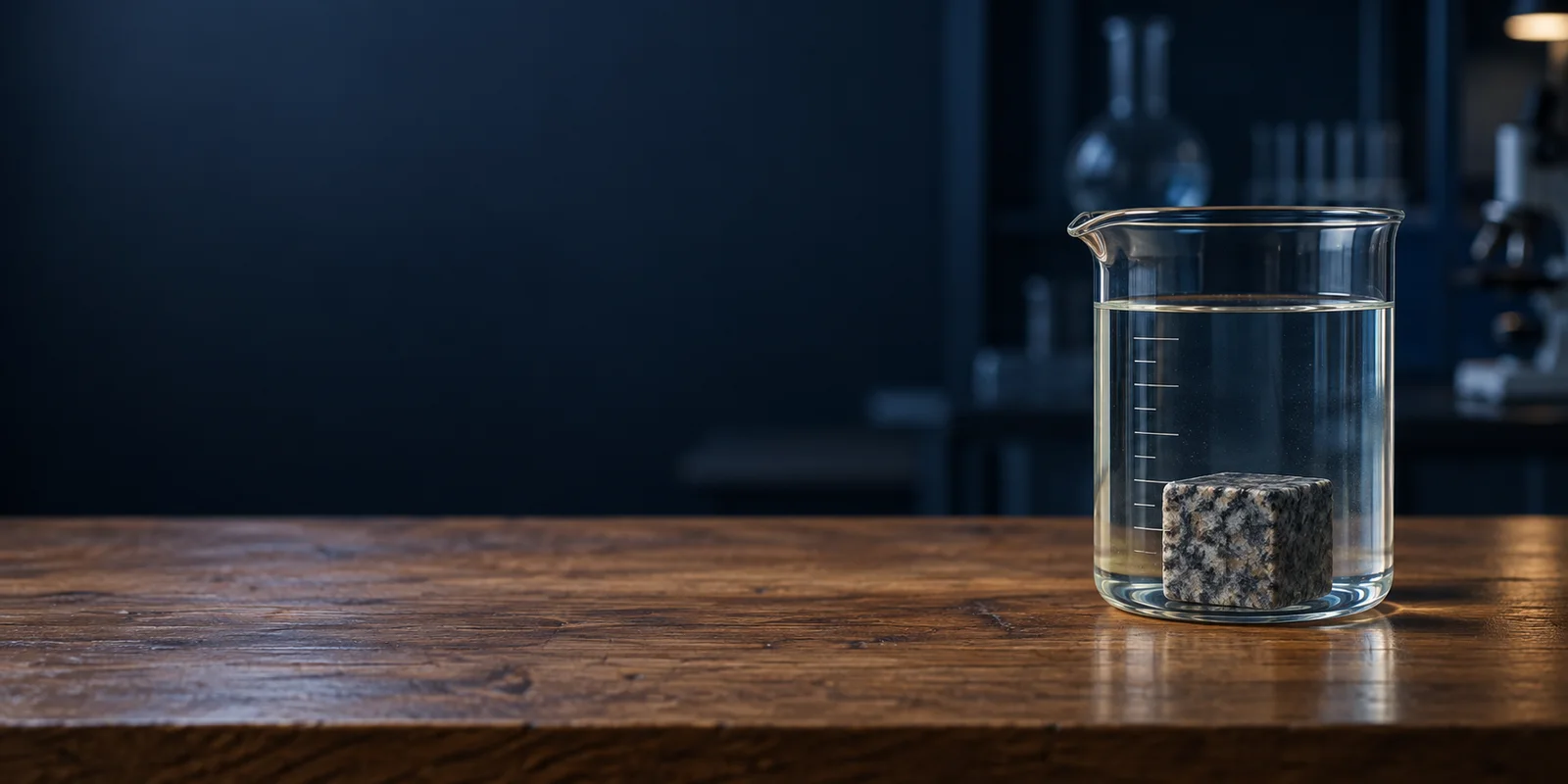
Matter is anything that has mass and occupies space (has volume). It can exist as a solid, liquid or gas. Matter is made of tiny particles that are in constant motion.
Solid
- Fixed shape and volume
- Particles close together
- Vibrate about fixed positions
Liquid
- Takes the container’s shape
- Nearly fixed volume
- Close particles move past each other
Gas
- No fixed shape or volume
- Particles far apart
- Easily compressed
2. Measuring Mass and Volume
Mass
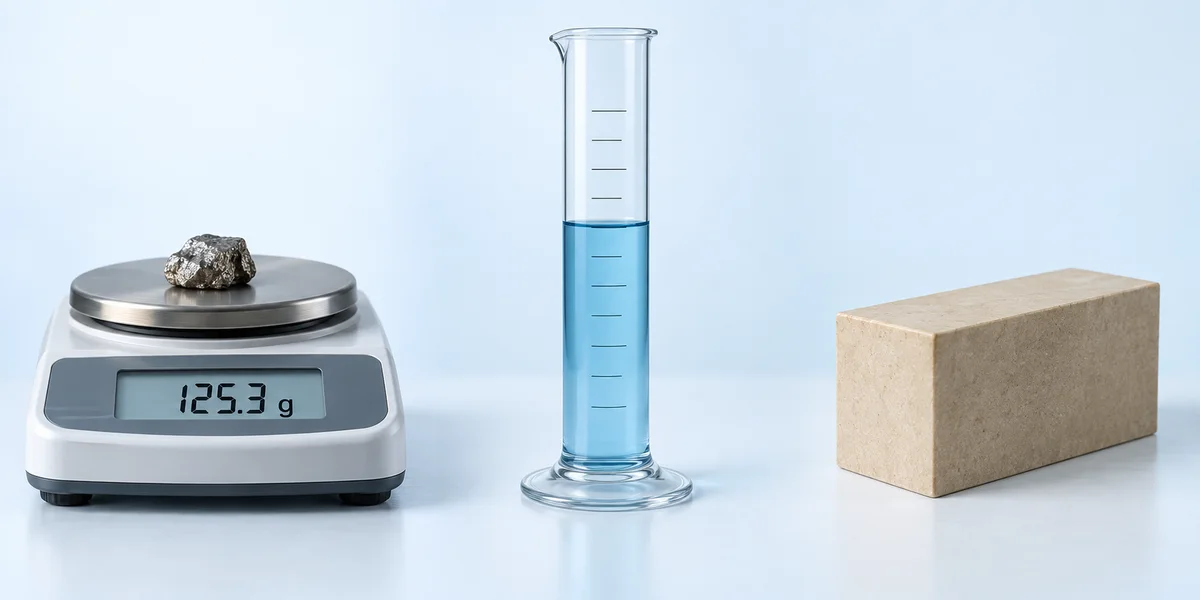
Use a balance. Tare it first or subtract the empty container.
SI unit: kilogram (kg).
1 kg = 1,000 g.
Volume: liquids
Use a measuring cylinder. Read the bottom of the water meniscus at eye level.
1 mL = 1 cm³.
1 L = 1,000 cm³.
Volume: regular solids
Measure a rectangular block’s length, width and height.
V = l × w × h
SI unit: cubic metre (m³).
Irregular solids, units & particle evidence
Displacement: fully submerge an insoluble object and subtract the initial water volume from the final reading. Remove trapped bubbles.
Conversions: 1 cm³ = 10⁻⁶ m³; 1 L = 1 dm³ = 10⁻³ m³. Convert all lengths to the same unit before multiplying.
Evidence: the erratic movement of suspended particles (Brownian motion) supports the molecular model. Gas pressure arises from collisions with container walls.
Remember: Heating does not make individual particles expand. It raises their average kinetic energy, so motion and often average separation increase.
Refresh your foundations: SI units & conversions · Scalar quantities.
3. Interactive: Calculate Density
= 2,500 kg/m³
Keep mass fixed and increase volume. What happens to density?
ρ = mass ÷ volume
Approximate reference densities. Temperature, pressure and composition matter.
4. Worked Example
A metal block has a mass of 540 g and a volume of 200 cm³. Calculate its density in kg/m³.
- ρ = m/V = 540/200 = 2.70 g/cm³
- 1 g/cm³ = 1,000 kg/m³
- 2.70 × 1,000 = 2,700 kg/m³
5. Practice Questions
- A block has a mass of 150 g and a volume of 60 cm³. Calculate its density.
- A liquid has density 0.80 g/cm³. What is the mass of 250 cm³?
- A cube has sides of 5.0 cm and density 2.4 g/cm³. What is its mass?
- Explain why gases are much easier to compress than liquids.
Check your answers
1. 2.5 g/cm³
2. 200 g
3. 300 g (V = 125 cm³)
4. Gas particles have much larger spaces between them.
6. Real-World Application
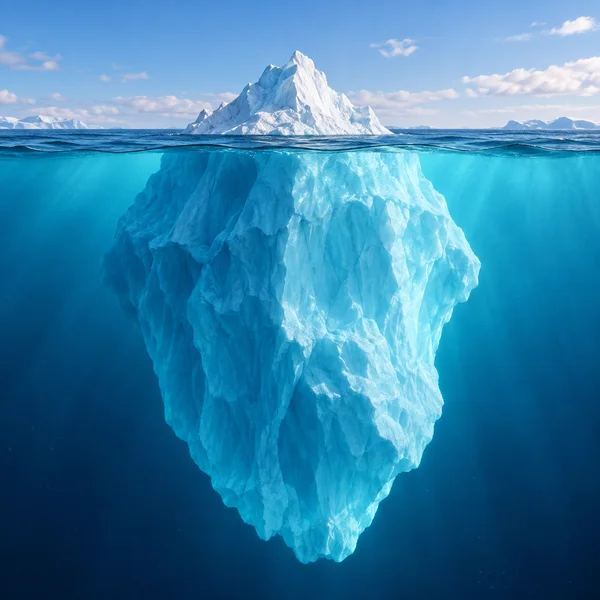
Why do icebergs float?
Ice is less dense than seawater. Using ρice ≈ 917 kg/m³ and ρsea ≈ 1,025 kg/m³, about 89% of its volume is submerged at equilibrium.
Particle modelSolid · Liquid · Gas
Switch states and adjust particle motion. This model is schematic: particles are not drawn to scale.
Choose a state
The motion control represents kinetic energy qualitatively; it does not change the number or size of particles.
Shapefixed
Volumefixed
Particle spacingclose, often ordered
Particle motionvibrate about positions
More Worked Examples
EasyA rectangular tank measures 40 cm × 25 cm × 20 cm. Find its volume in litres.
- V = 40 × 25 × 20 = 20 000 cm³.
- 1 L = 1000 cm³ → V = 20 L.
V = 20 L
MediumA block measures 20 cm × 10 cm × 5.0 cm. Find its volume in cm³, litres, and m³.
- V = 20 × 10 × 5.0 = 1000 cm³.
- Since 1000 cm³ = 1 L, the volume is 1.0 L.
- Multiply by 10⁻⁶ m³ per cm³: 1000 × 10⁻⁶ = 1.0 × 10⁻³ m³.
V = 1000 cm³ = 1.0 L = 1.0 × 10⁻³ m³
HardA measuring cylinder holds 120 cm³ of water; a stone is lowered in and the level reads 165 cm³. The stone's mass is 117 g. Find the stone's volume and density.
- Volume by displacement: 165 − 120 = 45 cm³.
- ρ = m/V = 117 ÷ 45.
- ρ = 2.6 g/cm³ = 2600 kg/m³.
V = 45 cm³; ρ = 2.6 g/cm³
ChallengingSteam occupies about 1600× the volume of the water that made it. Use the particle model to explain, and estimate the average particle spacing ratio.
- Same number of particles fills 1600× the volume — particle spacing, not particle size, changes.
- Spacing scales with the cube root of volume per particle: 1600^(1/3) ≈ 11.7.
- The average spacing becomes roughly 12 times the original spacing; the particles themselves have not grown.
Spacing grows by ∛1600 ≈ 12×; the particles themselves are unchanged
Quick Quiz
Five questions to check your understanding. Answers stay in this open page only.