Build solid deformation one idea at a time.
Start with the foundations, then explore advanced ideas and calculus at the depth your course needs.
7 of 7 lessons
Hooke's Law & Extension
Measure extension, identify proportional behaviour, and read stiffness from gradient.
Elastic Energy & Force–Extension Graphs
Use graph area for deformation work, recoverable energy, and spring combinations.
Stress, Strain & Young Modulus
Separate material response from specimen geometry and predict extension.
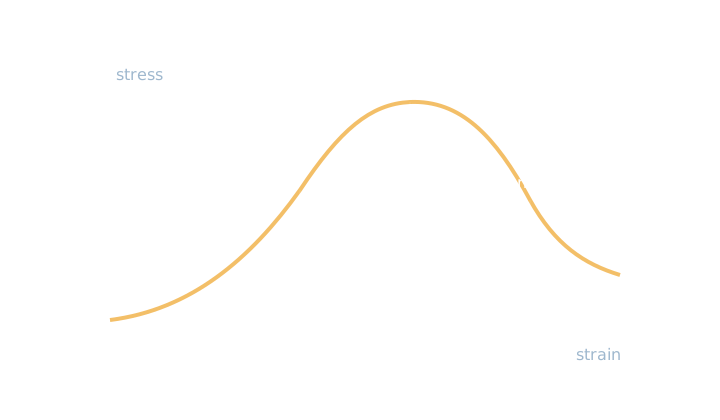
Stress–Strain Curves
Locate elastic response, yield, ultimate strength, necking, and fracture.
Elastic, Plastic, Brittle & Ductile Behaviour
Compare recovery, permanent strain, fracture styles, and hysteresis.
Material Selection & Deformation Modelling
Turn a design brief into stiffness, stress, geometry, and model checks.
Deformation Calculus
Differentiate force–extension curves and integrate stored energy.
Change one variable. Watch the physics respond.
Explore x = F/k, then take the idea into the full lessons.
Stretch a spring
A stiffer spring extends less under the same force.
Everything around the chapter, in one place.
Keep building with practice, classroom presentations, formulae, and a game that puts these ideas to work.
Exam practice
Questions, guided reasoning, and exam-style problem solving.
Browse exam questions →Formula toolkit
Keep the key relationships and their units close to hand.
Review formulae →Members · Classroom presentationClassroom slides
Reveal lesson ideas, examples, and checks in full-screen classroom mode.
Open slides →Lesson files
Find downloadable teaching resources and worksheets in the library.
View files →Bridge Load Tester
σ = F/A. Choose the thinnest cable that stays below yield and keeps the deck level.
Play the free chapter game →See it. Read it. Work it.
Connect diagrams to physical relationships and exam reasoning.
Explore diagrams →Guided support
Ask for a hint, check your reasoning, or explore a similar problem.
Ask GioAI →Key ideas to remember
Force and extension describe a sample. Stress and strain describe the material response. A design must check stiffness, strength, behaviour, geometry, and where the chosen model stops applying.
Move without losing your place.
Extra challenging questions
Take the ideas further with course-specific extension questions, supplied-data graphs and worked solutions.